

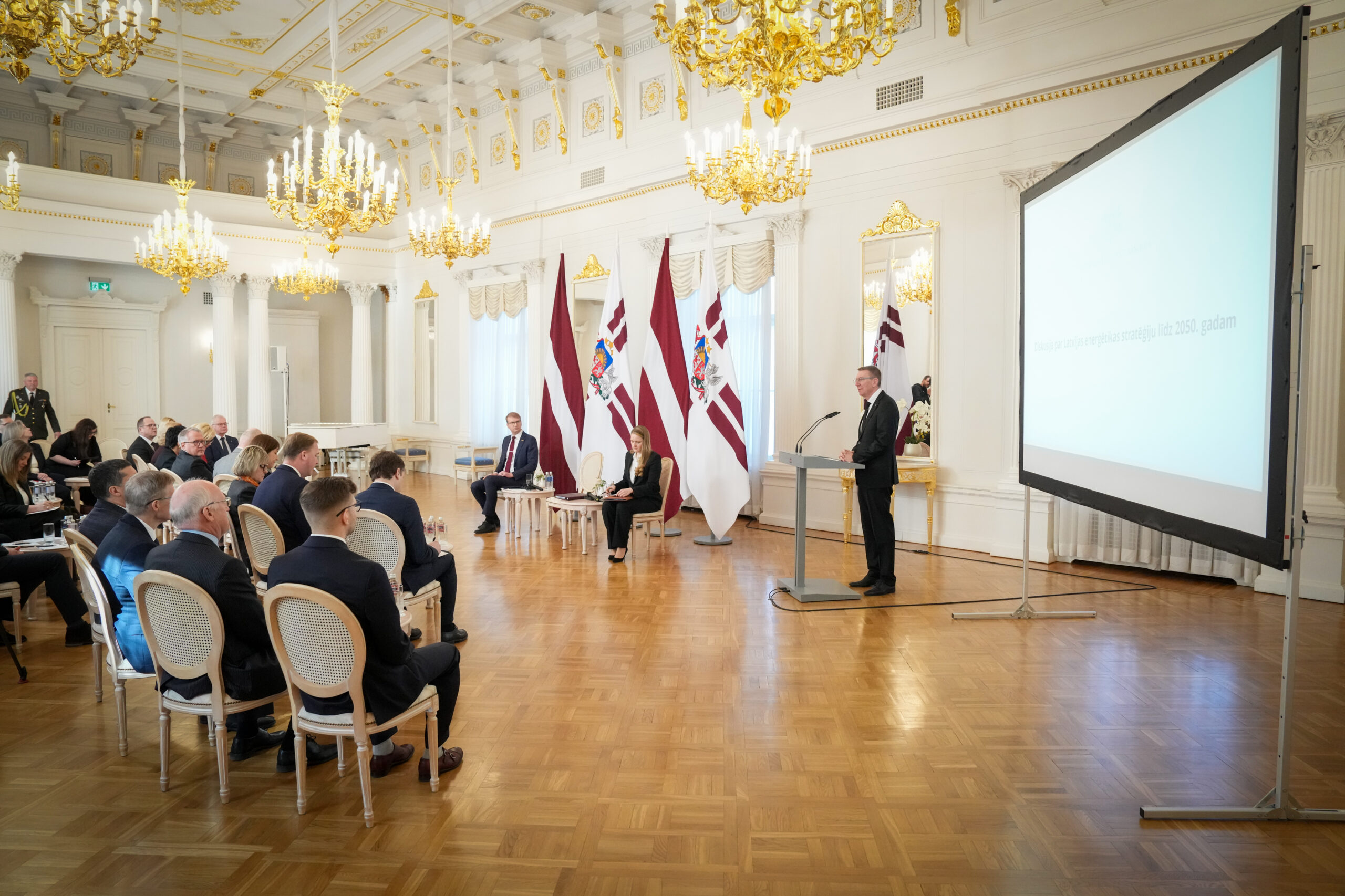
The Foreign Investors’ Council in Latvia (FICIL) participated in a high-level discussion on Latvia’s Energy Strategy 2050 held on 23 March at Riga Castle, initiated by the President of Latvia.
The discussion focused on the long-term development of Latvia’s energy sector, including energy security, diversification of resources, development of international interconnections, and strengthening domestic generation capacity to support economic growth and energy self-sufficiency. Particular attention was also given to challenges in energy project development, including regulatory clarity and implementation.
The discussion brought together government representatives, policymakers, and industry experts to exchange views on the implementation of Latvia’s Energy Strategy 2050 and the key challenges affecting the development of the energy sector.
FICIL was represented by Energy and Industrialisation Working Group leader Jānis Zuļķis (Gren), who contributed the investor perspective, focusing on the practical conditions required to ensure successful implementation of energy projects. From an investor standpoint, FICIL emphasised that alongside long-term strategic objectives, it is equally important to ensure a predictable, efficient, and execution-focused investment environment.
Within this framework, FICIL identified three key priorities. First, the need to accelerate project implementation timelines and strengthen coordination between state institutions and municipalities. A consistent interpretation and application of the Energy Strategy across all levels of governance is essential to reduce uncertainty and delays.
Second, FICIL underlined that investors assess Latvia within the broader Northern European region. As a result, competitiveness depends not only on energy prices, but also on the overall regulatory environment, access to infrastructure, and the ability of institutions to deliver timely and predictable decisions.
Third, FICIL emphasised the importance of strengthening key investment “enablers” within the public administration, particularly administrative capacity in areas such as environmental permitting. Insufficient resources in these processes continue to delay the implementation of already attracted investments.
“Attracting investment is only the first step; the decisive factor is implementation speed. By fixing administrative bottlenecks and fostering true cooperation, we can turn Latvia’s energy targets into a real competitive advantage.” Jānis Zuļķis, FICIL Energy and Industrialisation Working Group Leader
In addition, FICIL supports continued efforts to strengthen international interconnections and to assess long-term development options, including new generation capacities. FICIL welcomes the President’s initiative in convening this discussion and remains ready to engage with stakeholders to further develop practical, implementation-focused solutions.