

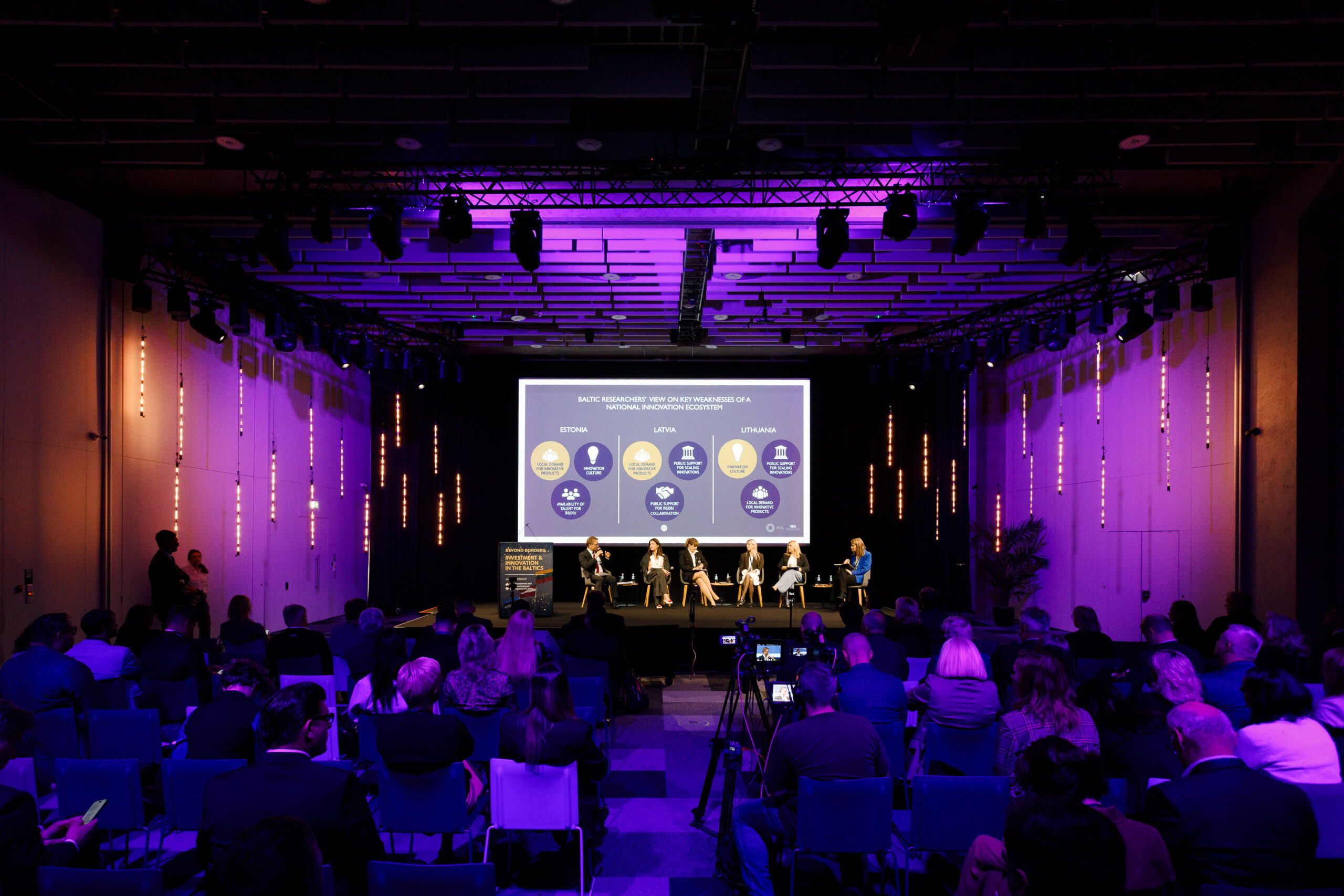
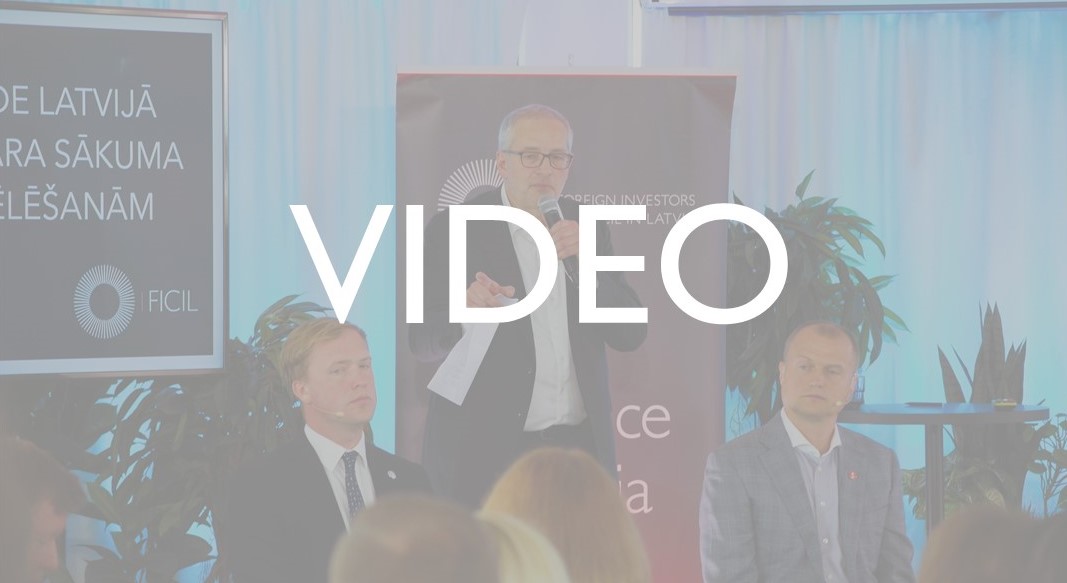
“Beyond Borders: Investment & Innovation in the Baltics”, a high-level forum held in Riga on 28 May 2026, concluded that the Baltic states have genuine competitive strengths in several strategic sectors, excellent infrastructure, talent, good innovation ecosystem foundation, yet lack policy coordination, financing mechanisms and business-research networks to turn those strengths into growth. Across three independent research presentations and open discussion among senior investors, business leaders, policymakers and researchers, a single message emerged: the region’s assets are in place. The region’s strengths are clear. The next challenge is scaling them faster and more effectively.
The forum was organised by the Foreign Investors’ Council in Latvia (FICIL), together with the Investment and Development Agency of Latvia (LIAA), the EIB Group Riga Office, the German-Baltic Chamber of Commerce in Estonia, Latvia and Lithuania (AHK), and RTU Riga Business School (RBS).
Latvia remains attractive to investors, while expectations for predictability and execution continue to rise
Based on the FICIL Sentiment Index 2026 findings, Latvia’s investment attractiveness continues to demonstrate resilience and stability, reflecting one of the strongest overall FICIL Sentiment Index assessments over the last two years. At the same time, investor sentiment has become more cautious, due to broader geopolitical and regional security uncertainty, as well as, internal political instability. As a result, only 47% of foreign investors plan to increase investment in Latvia, while 37% remain uncertain about their investment plans, representing the highest share of investors closely monitoring future developments before making investment decisions. Importantly, the share of investors who say they do not plan further investments in Latvia has decreased significantly — from 40% last year to 16% this year. This highlights a significant opportunity for Latvia to further strengthen investor confidence through effective implementation, stronger coordination, and continued progress in key reform areas.
The AHK Business Survey 2026 found that 60% of Latvian companies expecting turnover growth this year, which is a good sign. Investors acknowledged Latvia’s competitive tax system and skilled workforce, while also highlighting the importance of consistent implementation and policy predictability. Both studies underline the importance of continued progress in education, talent availability, migration policy, and demographic development in order to strengthen Latvia’s long-term competitiveness.
Stronger collaboration between Baltic business and research communities is becoming increasingly important
The FICIL Sentiment Index points to a limited collaboration between the foreign investors and the Baltic research community in Estonia, Latvia and Lithuania. Besides funding, one of the key challenges is strengthening incentives for researchers to engage more actively with industry and innovation commercialisation, alongside traditional academic excellence indicators. Moreover, the visibility of key scientific, technological and research achievements across the Baltic innovation ecosystem could be strengthened further. As a result, opportunities for stronger cooperation between the private sector and the research community remain underutilised. In view of this, the need for multi-stakeholder coordination and innovation ecosystem orchestration appears as a key message to the policymakers to untap innovation and investment potential of the Baltics.
Despite a lack of collaboration, both foreign investors and Baltic researchers have similar views on industries with high innovation potential and policy needs. This is one of the promising signs for stronger collaboration.
Latvia’s startup ecosystem is strengthening, while growth-stage scaling remains a key challenge
Preliminary findings from the EIB Advisory and LIAA showed that Latvia’s startup ecosystem is active and technically capable, with recognised strengths in fintech, deep tech and AI-enabled solutions, but held back when trying to grow. Latvia has secured only 4 EIC grant recipients since 2021, compared to 15 in Estonia and 17 in Lithuania. Moreover, 70% of Latvian scaleups have relocated abroad during later growth stages, highlighting the importance of stronger growth-stage financing mechanisms, greater availability of private capital, and national co-financing instruments for EU programmes to support the long-term scaling of innovative companies in Latvia.
The Baltics are increasingly seen as one region, while closer regional coordination remains an important next step
A consistent thread across the forum was the contrast between how the Baltic states are perceived internationally and how they operate in practice. Investors and EU institutions treat the region as a single unit. Estonia, Latvia and Lithuania continue to compete for funding, talent and investor attention, while participants also highlighted significant opportunities for stronger regional coordination and joint positioning.
Reinhold Schneider, Chairperson of the Board at Foreign Investors’ Council in Latvia, and CEO of SCHWENK Latvija and Northern Europe: “It is encouraging to see Latvia receive its strongest investment-climate assessment since 2019, a clear recognition of the country’s stability and the constructive work of recent years. At the same time, the findings remind us that confidence and commitment do not always move at the same pace. The willingness to invest is there, and I am confident that in close dialogue with the government and our Baltic partners, we can together create the conditions for that willingness to translate into real investment in the years ahead”.
Ieva Jāgere, Director General of the Investment and Development Agency of Latvia (LIAA): “Latvia has every opportunity to become one of Northern Europe’s leading innovation and technology hubs. We already have internationally competitive companies in deep tech, defence technologies, artificial intelligence, and advanced manufacturing, alongside an increasingly strong science and innovation ecosystem. According to the EY European Attractiveness Survey 2026, Latvia ranks 7th in Europe by the number of foreign investment projects per capita and 8th by the number of jobs created, demonstrating that international investors continue to see strong long-term potential in our economy.
However, the next stage of development will require much greater speed and ambition. Latvia must become significantly faster at transforming knowledge, research, and technology into globally competitive companies. That is precisely why we need new financing mechanisms, closer cooperation between government, science, and industry, and much stronger international partnerships across the Baltic and Nordic region.
In today’s global economy, competition is increasingly taking place not between individual countries, but between innovation ecosystems. Latvia’s advantage lies in its ability to be agile, fast-moving, and technologically capable — with exceptionally strong long-term growth potential.”
Paulina Brzezicka, Head of EIB Group Office in Latvia: “Latvia has all the ingredients of a strong innovation ecosystem – talent, sector diversity and international ambition. Yet too many companies struggle to move beyond the early stages or scale at home. The EIB’s role is not only to finance, but also to advise and connect the right financial instruments. Together with LIAA, we are helping Latvia build a more competitive innovation ecosystem and remove bottlenecks in access to EU funding, so that Latvian companies can grow and compete beyond borders.”
Florian Schröder, CEO at German-Baltic Chamber of Commerce: “The advantage of the Baltic countries lies in their openness, speed and adaptability to new developments. This gives the region strong innovation potential. The Baltics can become a living innovation laboratory for Europe – a smaller, agile model whose solutions can later be scaled across larger European economies”.
Claudio Rivera, Founding Director of Bachelor Program at RTU Riga Business School: “Latvia and the Baltic states can grow faster and stronger if we become more precise in how we turn our existing capabilities into strategic investment opportunities. Rather than focusing only on broad structural reforms, we need data-driven, targeted initiatives in sectors where the three Baltic states already show distinctive strengths in research, innovation, and investment potential.
By coordinating government, investors, universities, and research institutions around these priority sectors — ideally through cross-border Baltic initiatives — we can crystallize stronger innovation ecosystems and make European and private funding work with greater impact. At the same time, we must reduce the bureaucratic friction that too often slows down research and innovation programs, ensuring that energy is invested in building capabilities rather than navigating processes.
If we combine strategic sector focus with smarter, simpler innovation funding mechanisms, we will create stronger incentives for large companies not only to invest in research and innovation, but to become deeply engaged in shaping the region’s future competitiveness.”
The forum concluded that closing the gap between the region’s potential and its performance is achievable, but requires deliberate action on three fronts: stronger policy delivery; structural reform of how business and research collaborate; and a more coordinated Baltic approach. The assets are in place. What is needed now is the political and institutional will to connect them.
Information about research:
FICIL has conducted the Sentiment Index research since 2015. The central aim of research is to stimulate evidence-based policymaking to improve investment climate in Latvia. More information about research can be found on FICIL website: www.ficil.lv/sentiment-index/
AHK has conducted the Business Survey in the Baltic States as part of the wider AHK CEE Economic Survey, which has been carried out across Central and Eastern Europe since 2006. The survey assesses the current situation and expectations of AHK member companies, including their views on the economic outlook, business environment and key risks in the region. More information about the survey can be found on the AHK website: www.ahk-balt.org
EIB Advisory carried out an analysis of Latvia’s startup and scaleup financing ecosystem under the EIB Future Finance programme, in cooperation with LIAA. The aim of the analysis is to identify key barriers faced by startups and scaleups and to outline possible measures to improve access to finance, EU funding participation and innovation growth in Latvia.
Photos from the event are available HERE and HERE.